
What multitasking actually costs
Multitasking, as most people mean it, is doing two things that both want your attention. Writing an email during a meeting. Reading a message while someone is talking to you.
You are not doing both. You are switching between them, and paying a small price on every switch: finding your place again, reloading what you were holding in your head, noticing what changed while you were away. The price is small enough to ignore once and big enough to ruin an hour.
This is well covered ground, and the advice that follows it is always the same. Do one thing at a time.
That advice is right about attention and wrong about days.
Attention is the thing you cannot split. Time is not.
Rice takes 20 minutes. It needs you for about two of them, putting it on and taking it off. For the other 18 it does not care whether you are in the room.
A load of washing takes 50 minutes and needs you for none of them.
Doing something else during those 18 minutes is not multitasking. The rice is not competing for your attention. It is running on the clock, not on you.
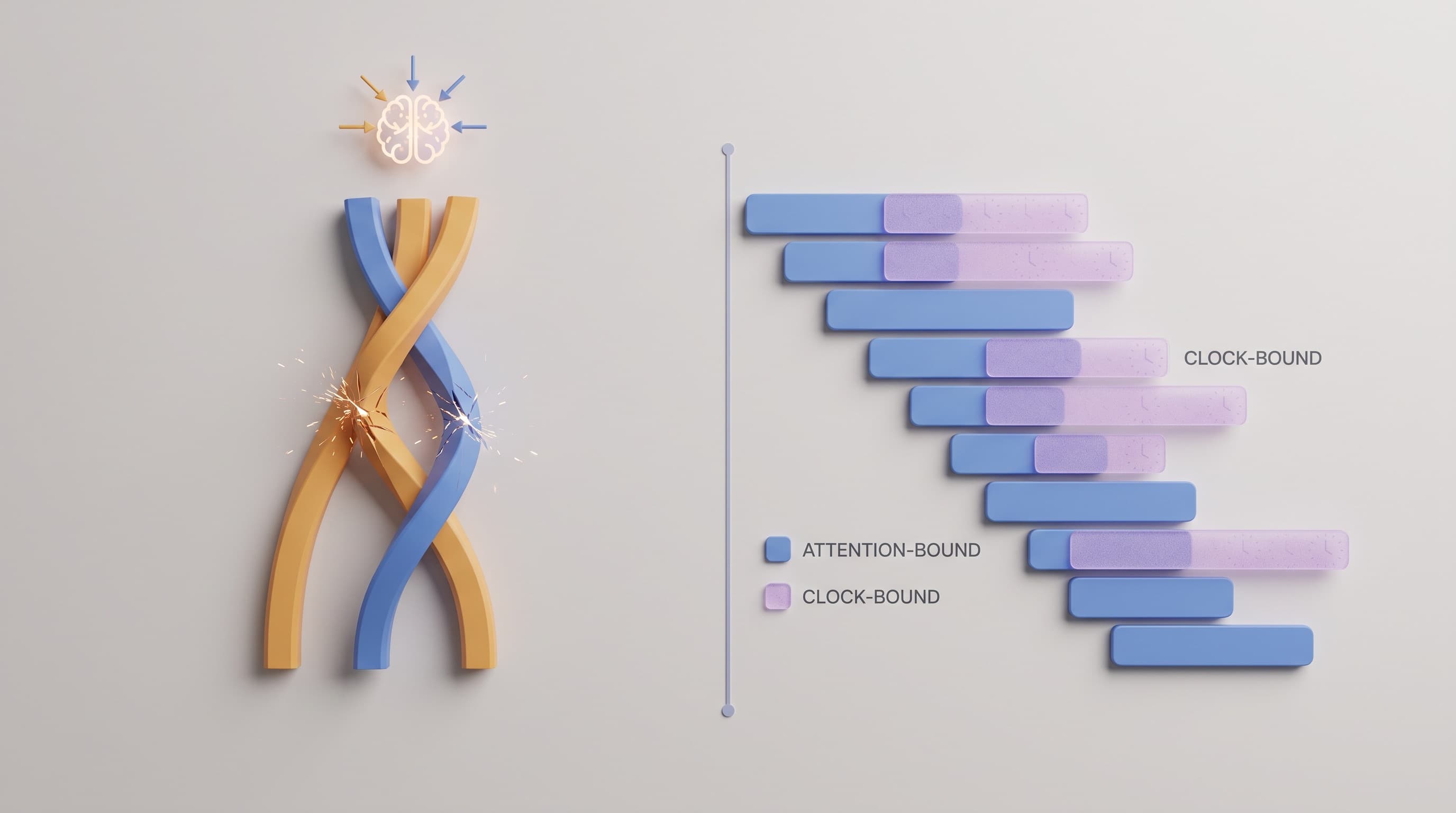
That is the whole distinction. Multitasking divides your attention between two things that both want it. Running tasks in parallel overlaps two things where only one wants it at any given moment.
A test for any task
Ask how much of the task's duration actually needs you.
Attention-bound.
Needs you the whole way through. Writing, a conversation, driving, anything you would call focused work. Two of these cannot overlap, and that is the real rule hiding underneath "do one thing at a time".
Clock-bound.
Needs you at the start, sometimes at the end, and not in between. Rice, laundry, an oven, dough proving, a long download.
Intermittent.
Needs you at intervals. A simmer that wants a stir every ten minutes. Sets at the gym with rest between them.
Most days are a mix of all three. Most people plan them as though everything were the first kind.
Why a to-do list hides this
A list is a sequence of identical rows.
Put the washing on
Chop the vegetables
Reply to Dan
Nothing in that shape tells you the first item runs by itself for 50 minutes. So you work down the list in order, and the washing finishes at four o'clock instead of ten past three, for no reason except the shape of the list.
A list has no dimension for how long something takes and no dimension for when it happens. Those are exactly the two things you need in order to overlap anything.
Start with what runs without you
The practical version is short. Start the clock-bound tasks first, then fill their dead time with attention-bound work.
Put the water on before you chop, not after. Start the washing before you sit down to work, not when you get up. Set the download going and then read the thing you were going to read anyway.
None of this is new to anyone who has cooked a roast. What is hard is holding four of them in your head at once, which is where writing it down on a timeline rather than in a list starts to matter.
The real limit is endings, not tasks
Overlapping is not free, and the cost is not where people expect it.
It is not that running four things at once splits your attention four ways, because it does not. It is that each of those four things ends. An ending demands your attention at a moment you did not choose. One at a time is fine. Three inside the same minute is a scramble, and it is genuinely worse than having done them in sequence.
So the number to watch is not how many tasks overlap. It is how many of them finish close together. If two endings land within a minute of each other, move one of them.
This is also why parallel work is so hard to hold in your head. You are not tracking three tasks, you are tracking three deadlines, and they arrive whether or not you are thinking about them.
"Do one thing at a time" is good advice about attention and bad advice about a day. Once you stop treating those as the same claim, most of the dead time in an afternoon turns out to be usable.